


Bipolar disorder doesn’t come with a user manual. Yet every day, over two million adults in America wake up and navigate its unpredictable terrain. Perhaps you’re one of them, or perhaps you love someone who is. Either way, there’s something remarkable about the human capacity to adapt to even the most challenging internal landscapes.
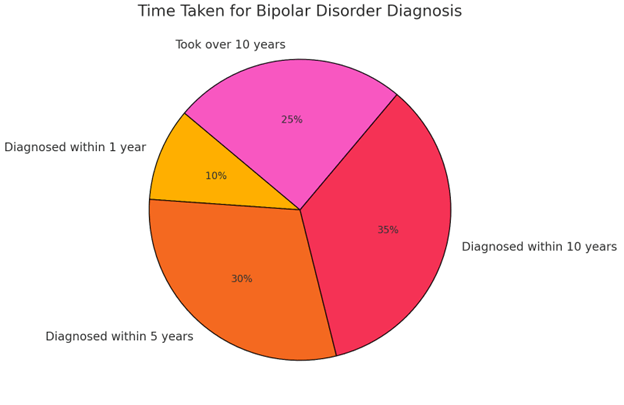
The journey to understanding isn’t quick – most people experience symptoms for nearly 10 years before receiving an accurate diagnosis. That’s a decade of wondering why your emotional experiences seem so different from others around you.
When Your Brain Writes Its Own Weather Forecast
Living with bipolar disorder means never quite knowing which version of yourself will show up tomorrow. It’s like your brain has its own atmospheric conditions that shift without warning – sometimes sending you soaring through clear, exhilarating skies, other times plunging you into storms that block out every ray of light.
During manic or hypomanic phases, you might feel extraordinarily alive. Thoughts race like shooting stars – brilliant, fast, impossible to catch. You might accomplish more in three days than others do in three weeks. Sleep feels optional when you’re fueled by ideas and possibilities that won’t stop coming.
Then the pendulum swings. Depression arrives like a heavy fog, slowing everything down. Tasks that once seemed simple now require tremendous effort. The world loses its color, its taste, its meaning. And perhaps most painfully, you can remember what it felt like to be energized and creative, but can’t find your way back there.

Beyond the Clinical Description
James, a software developer diagnosed with Bipolar I in his thirties, describes it this way: “It’s like everyone else gets to live in a world where the volume stays between 4 and 6. Mine goes from 0 to 11 with no warning. The high volumes are amazing until they’re terrifying. The low ones make me forget that sound exists at all.”
This isn’t just about mood swings. It’s about trying to build a consistent life, maintain relationships, and pursue goals when your internal experience refuses to stay steady. It’s about explaining to people you love why you were so different last week, and why you can’t just “snap out of it” today.
Finding Solid Ground
Here’s what’s encouraging: while bipolar disorder is a lifelong condition, it doesn’t have to define your entire life story. With proper treatment and support, many people learn not just to manage their symptoms, but to thrive despite them – and sometimes even because of the unique perspective they bring.
Effective management typically includes:
| Management Strategy | Description |
| Medication that works for you | Finding the right medication can take time, but when you find what works, it helps stabilize mood fluctuations without dampening your authentic self. |
| Therapy that builds skills | Approaches like Cognitive Behavioral Therapy (CBT) and Interpersonal and Social Rhythm Therapy (IPSRT) provide practical tools for recognizing triggers and maintaining stability. |
| Lifestyle strategies | Learning how sleep, nutrition, exercise, and stress management affect your particular brain chemistry. |
| Support networks | Building relationships with people who understand the terrain you’re navigating. |
| Self-awareness practice | Developing your ability to recognize early warning signs of mood shifts before they escalate. |
Your Experience Is Valid
Perhaps the most important thing to understand is that your experience is real and valid. Bipolar disorder isn’t a character flaw or a failure of willpower. It’s a neurobiological condition that affects how your brain processes emotions, energy, and information.
Elena, an artist who was diagnosed with Bipolar II in college, shared: “The biggest breakthrough in my recovery was finding a psychiatrist who told me, ‘Your brain works differently, not wrongly.’ That shifted everything for me. I stopped fighting myself and started working with my unique brain instead.”
Taking the Next Step
Wherever you are in your journey with bipolar disorder – whether you’re newly diagnosed, supporting someone who is, or still seeking answers for experiences that haven’t made sense – know that understanding and support are available.
Modern approaches to bipolar treatment are more sophisticated and personalized than ever before. With the right team, you can develop strategies that work specifically for your brain, your life, and your goals.
Living with bipolar disorder isn’t about eliminating every symptom. It’s about learning to work with your unique mind rather than against it, finding stability without sacrificing authenticity, and building a life where bipolar disorder is something you have, not something that has you.
Recommended Resources
- The Bipolar Disorder Survival Guide by David J. Miklowitz – A practical, compassionate guide for both individuals and families
- Take Charge of Bipolar Disorder by Julie A. Fast – Written by someone who lives with the condition, offering real-world strategies
- Depression and Bipolar Support Alliance (DBSA) – Provides online and in-person support groups, educational resources, and wellness tools
- An Unquiet Mind by Kay Redfield Jamison – A memoir by a leading psychiatrist who also lives with bipolar disorder
- International Bipolar Foundation – Offers free educational webinars, a supportive online community, and research updates
Remember: Your story isn’t just about managing a condition. It’s about creating a life of meaning, connection, and purpose – one where bipolar disorder is just one chapter, not the entire narrative.
Ready to write the next part of your story? We’re here to help when you’re ready to take that step. Our clinicians are available to help 212.621.7770 and info@mindbody7.com.


Cited Research Articles
Harrison PJ, Cipriani A, Harmer CJ, Nobre AC, Saunders K, Goodwin GM, Geddes JR. Innovative approaches to bipolar disorder and its treatment. Ann N Y Acad Sci. 2016 Feb;1366(1):76-89. doi: 10.1111/nyas.13048. PMID: 27111134; PMCID: PMC4850752. https://pubmed.ncbi.nlm.nih.gov/27111134/
Goes FS. Diagnosis and management of bipolar disorders. BMJ. 2023 Apr 12;381:e073591. doi: 10.1136/bmj-2022-073591. PMID: 37045450. https://pubmed.ncbi.nlm.nih.gov/37045450/
Grande, I., Berk, M., Birmaher, B., & Vieta, E. (2016). Bipolar disorder. Lancet, 387(10027), 1561–1572. https://doi.org/10.1016/S0140-6736(15)00241-X
Bonnín CDM, Reinares M, Martínez-Arán A, Jiménez E, Sánchez-Moreno J, Solé B, Montejo L, Vieta E. Improving Functioning, Quality of Life, and Well-being in Patients With Bipolar Disorder. Int J Neuropsychopharmacol. 2019 Aug 1;22(8):467-477. doi: 10.1093/ijnp/pyz018. PMID: 31093646; PMCID: PMC6672628. https://pubmed.ncbi.nlm.nih.gov/31093646/

A Message From Dr. Lewis If you’ve been struggling with depression or anxiety, I want you to know something important:

The Conversation That Surprised Me A few years ago, I had a patient named Greg who’d been on escitalopram (Lexapro)

The link between yoga and mental health has become sufficiently well established as to be practically mainstream. What was associated

You’re Not Meant to Go Through Life Alone In our increasingly connected yet often isolating world, you might sometimes feel