

Telehealth vs. In-Person Therapy: Finding Your Perfect Fit

Remember when our only option was sitting on a therapist’s couch? Then came the pandemic, and suddenly we were all staring at our screens, pouring our hearts out through video calls. Now that we have choices again, something fascinating is happening: many people are choosing to stay virtual, even when the office doors are open again.
As someone who works with clients both online and in-person, I’ve witnessed this shift firsthand, and I’m intrigued by how people decide what works best for their mental health journey.
The Numbers Tell a Story of Transformation
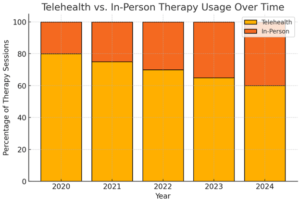

The data confirms what I’m seeing in my practice:
- About 80% of mental health providers offered telehealth during the pandemic
- Even in 2024, approximately 60% of therapy sessions still happen online
- Patient satisfaction with virtual mental health care hovers around an impressive 85%
- Nearly 75% of clients express a desire to keep telehealth as an option
What these numbers tell me is that telehealth isn’t just a temporary solution—it’s become a permanent and valuable part of how we approach mental health care.
Why Many of My Clients Prefer Virtual Sessions
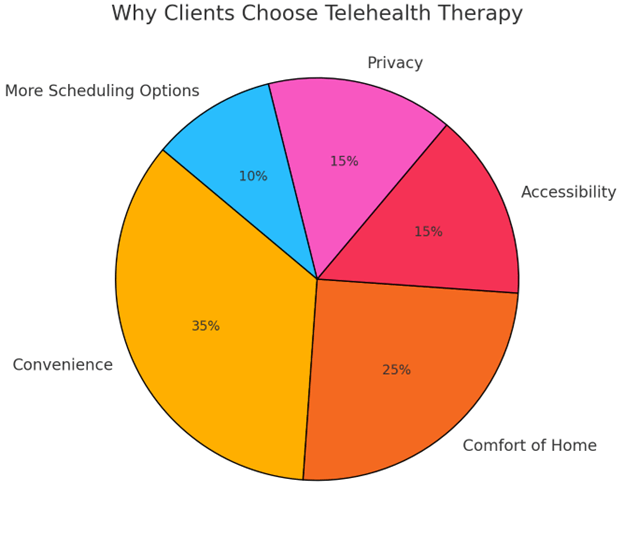
When I ask clients why they choose to stay virtual, their answers reveal how deeply convenience affects our ability to prioritize mental health:
The Convenience Factor
For busy professionals and parents, eliminating commute time makes therapy more accessible. I’ve had clients tell m
e they can now fit sessions into lunch breaks or after their children are asleep—times when traveling to an office would be impossible.
The Comfort of Familiar Space
There’s something powerful about processing difficult emotions in your own environment. One client mentioned how much easier it was to open up while sitting in her favorite chair with her cat on her lap—something that would never happen in my office!
The Accessibility Breakthrough
I’ve been able to work with clients who live in therapy deserts—areas with few mental health providers. Others can now connect with specialists who understand their specific challenges, regardless of location. And for those with chronic illnesses or mobility issues, telehealth has opened doors that were previously closed.

When the Traditional Couch Still Calls
Despite telehealth’s benefits, many people find irreplaceable value in coming to the office:
The Human Element
There’s an energetic exchange that happens when two people share physical space. Some clients tell me they can feel a deeper connection when we’re in the same room, and I notice subtle body language that might be missed on screen.
The Power of Boundaries
Walking into a space dedicated solely to your mental health creates a powerful psychological boundary. One client described it as “crossing a threshold where I can leave everything else behind.” There’s also complete privacy from family members, which not everyone has at home.
Special Therapeutic Needs
For complex trauma work, in-person support often feels safer. Group therapy tends to flow more naturally face-to-face, and certain psychological assessments work better in person. And for crisis situations, there’s no substitute for direct, immediate intervention.
Making the Choice: Your Life, Your Therapy
Consider what matters most for your unique situation:
Your Lifestyle Reality
How busy is your schedule? What’s your commute situation like? Do you have reliable private space at home? How comfortable are you with technology? The answers to these questions often point toward the format that will help you show up consistently for therapy.
Your Mental Health Needs
Different therapeutic approaches and presenting issues may benefit from different formats. What type of therapy are you doing? How severe are your symptoms? Do you personally benefit from physical presence? What environment helps you feel most comfortable opening up?
The Hybrid Approach: A Growing Trend
One of my favorite developments is watching clients create personalized combinations:
- In-person sessions for deep emotional work or major life transitions
- Telehealth for regular check-ins and medication management
- Switching between formats based on schedule or need
- Starting in person to establish connection, then transitioning to virtual
This flexibility allows therapy to adapt to your life, rather than forcing your life to adapt to therapy.
Setting Yourself Up for Success
For Virtual Sessions:
- Create a dedicated therapy space at home
- Use headphones for better sound and privacy
- Have a backup plan for technical issues
- Test your setup before important sessions
For In-Person Sessions:
- Plan travel time realistically
- Arrive a few minutes early to decompress
- Consider how office visits will fit into your schedule
- Make the commute work for you (podcast time, perhaps?)
The Future Is Flexible
What I’ve learned from working with hundreds of clients is that mental health care works best when it adapts to your life rather than the other way around. Whether you choose virtual, in-person, or a mix of both, what matters is finding what helps you show up consistently for your mental health.
The Bottom Line
The best format for therapy is the one that works for you—period. Don’t let anyone tell you virtual therapy isn’t “real” therapy, or that you’re missing out if you’re not meeting in person. What matters is that you’re getting the support you need in a way that fits your life.
Are you ready to explore your options? At Dr. Lewis and our clinic Mind Body Seven, we offer both virtual and in-person sessions, so you can find your perfect fit. Sometimes that means trying both to see what feels right. And remember—you can always change your mind. Because mental health care should be as dynamic as you are.


Cited Research Articles
Barnett, P., Goulding, L., Casetta, C., Jordan, H., Sheridan-Rains, L., Steare, T., … & Johnson, S. (2021). Implementation of telemental health services before COVID-19: Rapid umbrella review of systematic reviews. Journal of Medical Internet Research, 23(7), e26492. https://doi.org/10.2196/26492
Murphy, L., Parnass, P., Mitchell, D. L., Hallett, R., Cayley, P., & Seagram, S. (2009). Client satisfaction and outcome comparisons of online and face-to-face counselling methods. British Journal of Social Work, 39(4), 627–640. https://doi.org/10.1093/bjsw/bcp041
Schuster R, Fischer E, Jansen C, Napravnik N, Rockinger S, Steger N, Laireiter AR. Blending Internet-based and tele group treatment: Acceptability, effects, and mechanisms of change of cognitive behavioral treatment for depression. Internet Interv. 2022 Jun 1;29:100551. doi: 10.1016/j.invent.2022.100551. PMID: 35722084; PMCID: PMC9204733. https://pubmed.ncbi.nlm.nih.gov/35722084/

A Message From Dr. Lewis If you’ve been struggling with depression or anxiety, I want you to know something important:

The Conversation That Surprised Me A few years ago, I had a patient named Greg who’d been on escitalopram (Lexapro)

The link between yoga and mental health has become sufficiently well established as to be practically mainstream. What was associated

You’re Not Meant to Go Through Life Alone In our increasingly connected yet often isolating world, you might sometimes feel